Great Things Are Happening at the Wagner Lab!

Here’s More

The primary work of the Wagner Lab is greater a understanding of classification and identification of Specific Learning Disorders in Reading. We study specific learning disorders (SLDs) in word-level reading and in reading comprehension that are a public health and educational concern given their prevalence and persistence. It is estimated that between 3% and 20% of children experience SLDs in word-level reading while 8% to 10% encounter SLDs in reading comprehension. Using the most conservative estimates, this indicates that, in the United States alone, over 5.5 million children and their families are potentially grappling with the challenges and negative consequences that accompany these conditions.

Our aims are motivated by the critical need to develop improved models of identification and classification that are better informed by the substantial research literature on SLDs. Achieving the goal of improved models of identification and classification for SLDs in both word-level reading and in reading comprehension requires a two-pronged effort. The first is additional more basic research on issues associated with underlying theoretical models that potentially have implications for improved identification. The second is additional more applied research on the identification and classification models themselves.

In addition to the basic science aspect of our work, we are also interested what supports are most effective in supporting readers with specific learning disorders. We are especially interested in the application of Assistive Technologies.

All the good research in the world is of no value if it isn’t put into the hands of people who need it and can use it. So for that purpose we are working on a translational aspect that helps individuals with SLDs, their families, teachers, policy makers and other researchers access our work and apply it productively in their lives.

Finally, we are invested in the next generation of researchers. Our project includes students (undergraduate and graduate), post docs, and early career researchers. The experiences here will inspire these researchers to be invested in helping readers be successful.

It costs approximately $370,000 each year for our lab to do this work. With grant money being eliminated, there is a chance that our work (or parts of our work) will be cut back or stopped. This is why we are asking the public to help support us.

Donate to the Florida State Psychology Fund and designate the Wagner Lab to support our valuable work. You can use the link below or contact the Psychology Department and designate a gift to F09778 The Psychology Lab Fund, and earmark the Wagner Lab.

https://give.fsu.edu/Donate/WizardCheckout/b90183c2-471a-4e8e-362b-08d95cff3b29

As we look forward to finding new ways to fund our work on dyslexia and discuss proven tools to help readers (such as assistive technology) we will be updating this website regularly.

We will also be building a page on the website about dyslexia — facts and misconceptions and highlighting ours and other’s research that supports accurate information about dyslexia and what works to help dyslexic readers.

As we are a practical, solution-oriented team, we will also provide information about what works, what lies ahead and what policy makers need to know.

What we can’t provide (though we can make some suggestions of where to find this information) is testing or specific guidance for individuals with dyslexia. We hope that you will be excited about our work and willing to support us financially as other sources of funding become less predictable and stable.

Our work is in Year 18 of a 20 year old cycle and we have accomplished and published so much. We really do want to see our work come to fruition. You can help! Please feel free to reach out to us on our contact page, or call 850-645-7428 or email zirps@psy.fsu.edu.

2025 has been a productive and active time at the lab with multiple meta-analyses underway as well as advanced statistical training and progress made in our understanding of word level reading disorders as well as specific reading comprehension disorders. Our team has been looking at the home environments of children who develop dyslexia and in addition we are studying the use of assistive technology to help struggling readers.

The Department of Education released a statement of their priorities for funding May 21, 2025. One of the core priorities is evidence based literacy. Providing an empirically supported model of reading disorders (dyslexia) is central to our work. We have developed a model of dyslexia that takes into account causes, correlates, and consequences — all research driven. We are looking at how we can bolster the reading performance of students with dyslexia using assistive technology and better prediction of possible difficulties.

Our lab currently includes faculty, staff, a post doc, two graduate students, multiple undergraduate research students, DIS students, and consultants. The lab has been part of an NICHD funded center grant for the past 17 years. Our work has been to pull together all of these components and create a strong research foundation for understanding dyslexia. The current grant cycle (we are in year 3 of 5) highlights dissemination of the work to schools, families and communities so that practical solutions can be implemented.

It is exciting to have so many researchers (new and seasoned) focusing on dyslexia and how we can be of help to those who struggle with word reading and comprehension. And also to be at the cutting edge of understanding how to prevent, predict, and lessen the difficulties of dyslexia.

We are looking for a Post Doc (April 2024)!

POST-DOCTORAL FELLOWSHIP IN APPLICATION OF ADVANCED METHODS TO
STUDY LEARNING DISABILITIES AT FLORIDA STATE UNIVERSITY
We are recruiting a Post-Doctoral Fellow to assist with our ongoing research projects being
carried out in association with the NICHD-funded P50 Center titled the Learning Disabilities Translational Science Collective: Building on the Florida LDRC. The mission of the Center is to increase our understanding of the nature and origins of learning disabilities and to apply this knowledge to improve prevention, early identification, and remediation. This 2-year position is funded by the FSU Foundation and is a research assignment with no teaching requirement. Consequently, this position is ideal for a candidate who aspires to become a professor in a major research university.

A PhD in psychology, education, statistics, communication disorders, or a related field is
required by the date of appointment but is not required for applying. The successful candidate will have experience with or interest in learning how to do meta-analysis, model-based metaanalysis (MASEM), and structural equation modeling. Training will be available. A substantive research interest in reading or language disorders is desirable but not mandatory. Opportunities exist for participation in data analysis, manuscript preparation, grant writing, and collaboration with ongoing research projects in addition to continuing to pursue one’s own areas of research interest.

Interested candidates should send a CV; a cover letter describing relevant experience, skills, and future goals; and arrange to have three letters of recommendation sent directly to Rick Wagner at rkwagner@psy.fsu.edu. Consideration of applications will begin immediately and will continue until the position is filled. The start date is negotiable, but no earlier than August 26, 2024.


FSU is an Equal Opportunity/Access/Affirmative Action/Pro Disabled & Veteran Employer.
FSU’s Equal Opportunity Statement can be viewed at:

Click to access EEO_Statement.pdf

For more information:

https://psy.fsu.edu/~wagnerlab/opportunity.html

Thank you Ft Braden Teachers, Staff and Students

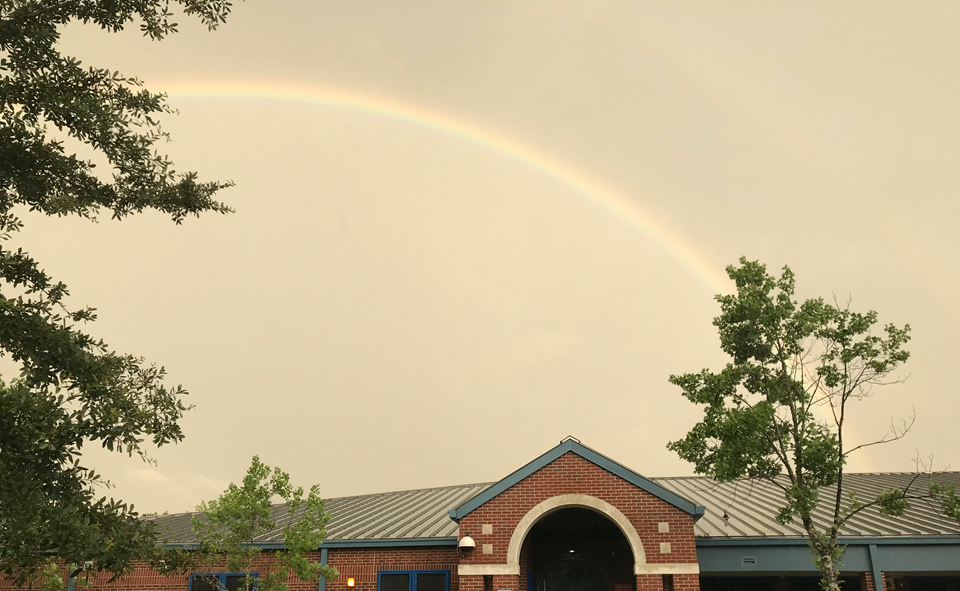
Right before everything shut down due to COVID 19 we had just finished our research project on Assistive Technology at Ft Braden School. We would like to thank all of the teachers and staff who made this project possible and especially Ms. Kim Sims, Assistant Principal, who made it possible for us to do the work. We thank the parents and guardians of the students we tested. We give a big thanks to the wonderful students! We ended up with an even 100 students completed and no missing test data which is pretty amazing! This data set will yield a great deal of interesting information and is being analyzed by the lab and by Sarah Wood, doctoral student over the summer. We hope we will see you again soon Ft. Braden! Ft Braden with Rainbow

Research at Ft Braden begins!

tester practice

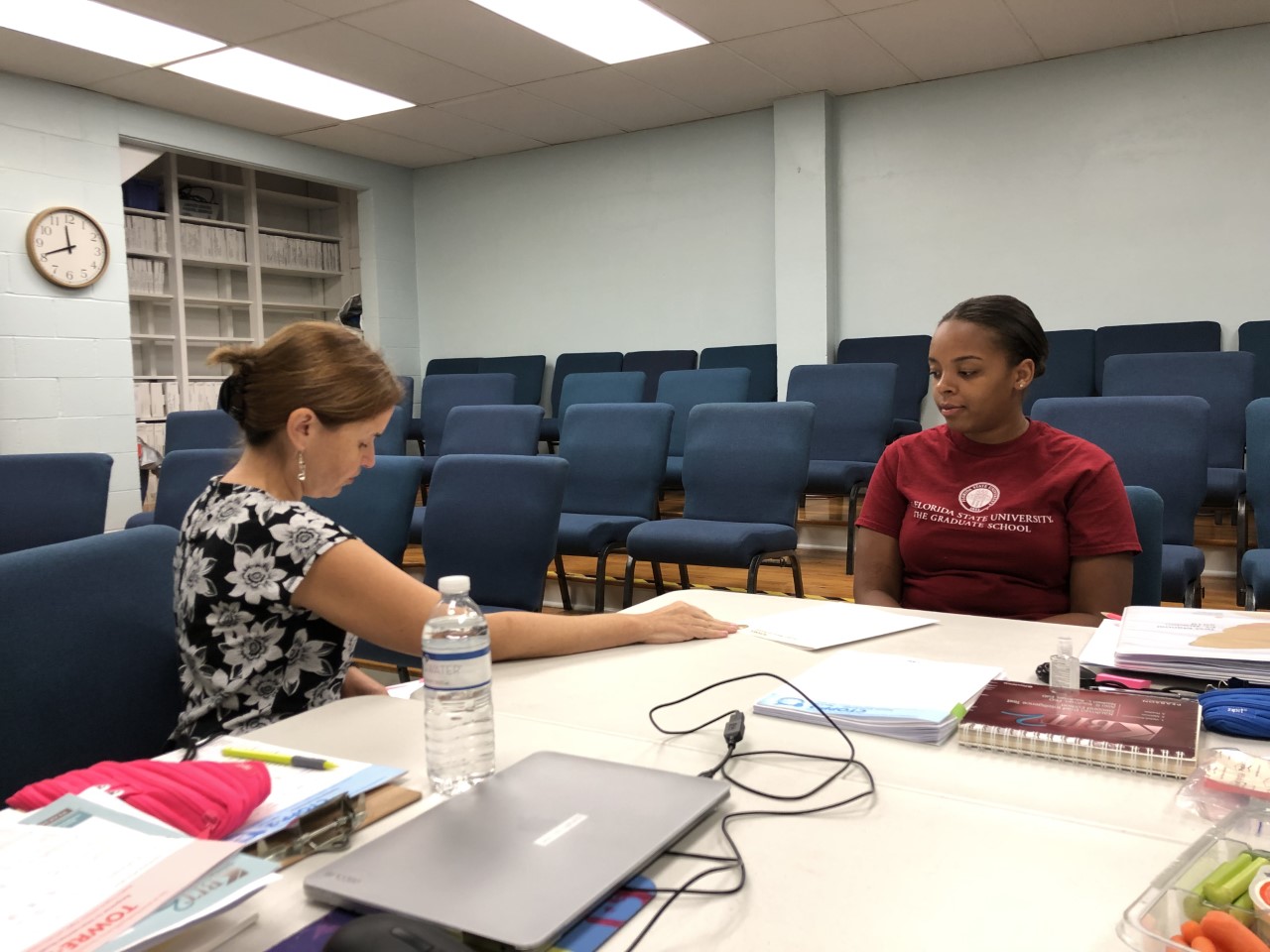
Research involving testing students is a complex process. Here Karen and Fabienne practice the measures many times until they can administer them perfectly. We are very appreciative of all the support we have received at Ft. Braden School and can’t wait to get the testing going tomorrow. We can’t thank our team, the school and the families enough.  And an extra special thanks to Ms. Kim Sims, the Assistant Principal. We hope to learn a great deal about assistive technology and dyslexia through this process. Look at the publications page to see more about the work that is being done at the WagnerLab!

Get your copy just in time for the holidays!

Antje and our book


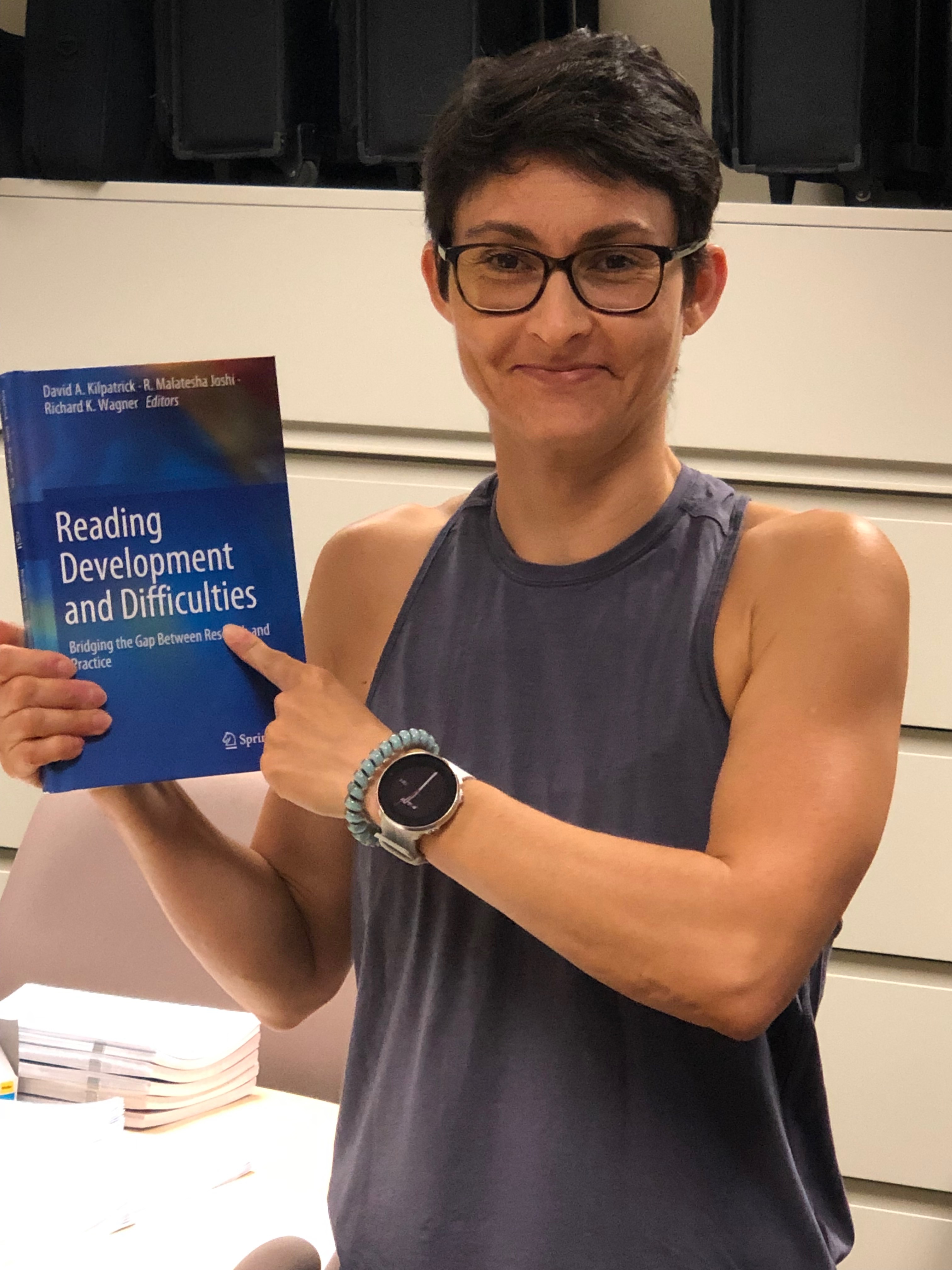
We are very proud to announce the publication of Reading Development and Difficulties: Bridging the Gap Between Research and Practice. David Kilpatrick, R. Malatesha Joshi and our own Rick Wagner are the editors. Our team (Wagner, Shenoy, Koh, Zhong, Joyner, Wood, Malkowski and Zirps) has a chapter, “Reading Related Phonological Processing in English and Other Written Languages.” Get your copy today!

Exciting Partnership with Ft. Braden School

We could not be more excited about our research in collaboration with Ft. Braden School. We are conducting research to understand the relationship of text-to-speech assistive technology for readers with dyslexia/learning disabilities. The project will include 100Ft. Braden Logo readers in grades 3-6.  The data set that will result from this research will form the basis of Sarah Wood’s dissertation and further her work on assistive technology. We greatly appreciate the generous partnership with Ft. Braden leadership, staff, teachers, parents/guardians and students. We hope to be able to conclude our work by the end of January 2020.  

Commentary on two classroom observation systems: moving toward a shared understanding of effective teaching.

Connor, C. M. (2013). Commentary on two classroom observation systems: moving toward a shared

understanding of effective teaching. Social Psychology Quarterly, 28, 342-346. DOI: 10.1037/spq0000045.


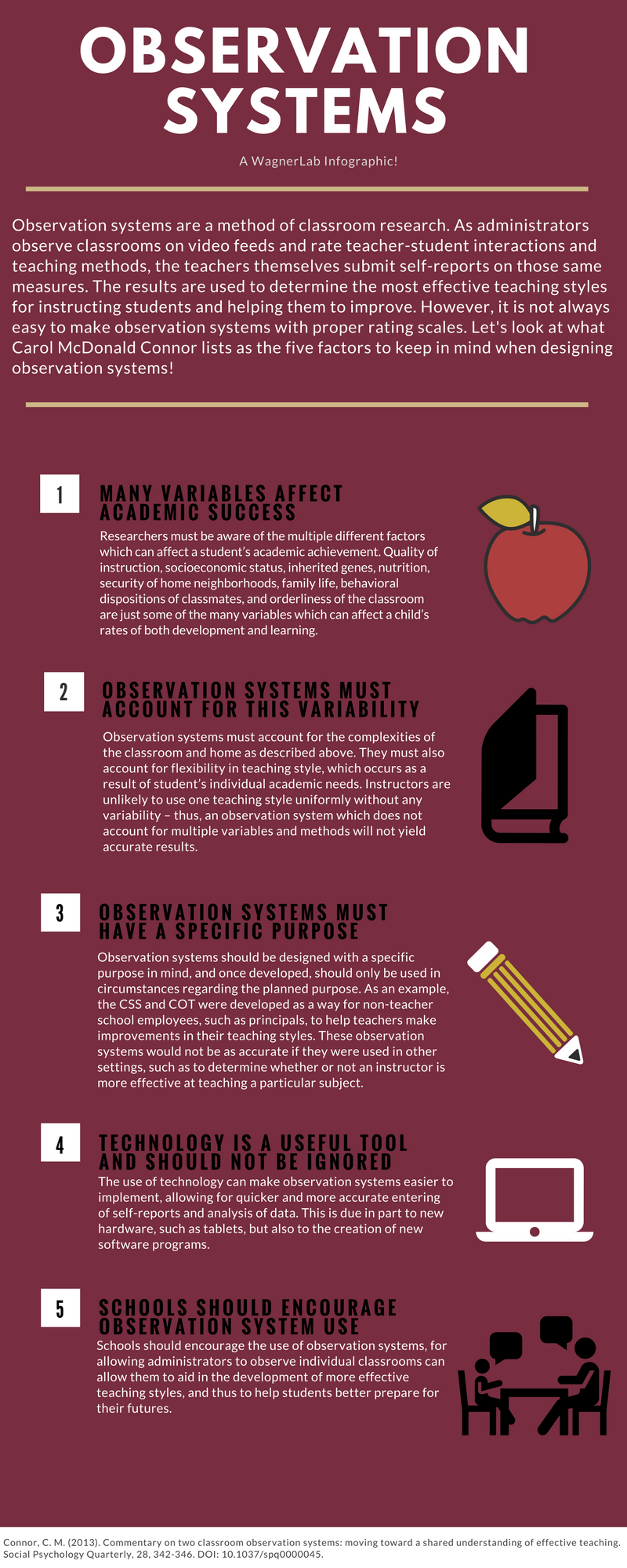
Education researchers often create observation systems in order to better understand how children behave and function in classroom settings and how their instructors respond to and educate them. While researchers or other observers, such as school principals, watch a livestream of the classroom, teachers make written observations and notes based on their interactions with students and the ways in which they instruct them. The results obtained allow researchers to help educators develop new teaching strategies that can be used in order to further growth and the acquisition of knowledge in our schools. However, designing observation systems which are able to accurately measure children’s outcomes and experiences can be challenging; Connor, in a 2013 review, argues that there are five main concerns for researchers to keep in mind when working with observation systems. These five points involve: the difficulty in making observation systems accurate, accuracy being greater in systems which account for the complexity of classroom environments, accuracy being greater if researchers have a specific goal for their system in mind when developing it and if they use the system specifically for the planned purposes, the usefulness of technology, and the need to keep the use of observation systems as an accepted part of a school’s guidelines.

Observation systems are difficult to make because of the wide variety of situational elements which exist that can impact a student’s educational achievement. The quality of the teaching they are given is of course important, but socioeconomic status, family life, inherited genes, security of home neighborhoods, order in the classroom environment, and other factors can also influence development and thus learning. Therefore, the importance of the second point comes to light: in order to yield increases in correlation strength when comparing the relationships between students’ scores in observation systems and their actual classroom performance, observation systems must account for factors aside from just a teacher’s skill level. These can be partially seen in the COT and CSS, two observation systems which moderately predict student achievement in several different assessments due to the factors they control for and due to the fact that they don’t praise one of two teaching styles over another; they show the strengths of both. However, even these two observation systems have their limits; they do not control for teaching styles other than the two factored into their creation, and do not take into consideration the fact that learning styles can be mixed and that learning experiences can fluctuate wildly even within the same classroom. Observation systems should account for the strengths of various teaching styles and environments; there is a need for teachers to use flexibility in teaching, allowing them to change up methods of information presentation when working with individual students in order to cater to their unique intellectual needs. Students’ behavioral dispositions can also impact their classmates, thus leading to other effects on learning.

It has been suggested that specificity in observation systems can lead to stronger correlations in predictive ability – an observation system focused on math leads to better predictions of math achievement than does a system which tests students’ general abilities, for example. This leads to Connor’s third point, one which the CSS and COT appear to have excelled in: designing observation systems to test specific situations, and using these systems only in those situations for which they were originally crafted. As Connor describes, “the CSS and COT have been designed to be used by educational leaders to inform the professional development of teachers and the improvement of their classroom instruction. Their utility would be undermined if they were suddenly used for teacher evaluation and retention” (Connor, 2013, p. 344). If the CSS and COT are used for purposes that they were not designed to evaluate, then their usefulness as a tool will decrease. Of course, observation systems do not have to be used alone; the use of technology can be of great help in determining the effectiveness of various teaching strategies. Newly developed hardware (such as iPads) and software can make it easier to statistically analyze data, and can also make teachers’ recordings of student behavior significantly easier to complete, thus increasing the accuracy of these self-reports and eliminating some research concerns. Finally, by encouraging the use of observation systems, school administrators can be made more aware of what is going on in classrooms and can help teachers in the developments of more effective teaching practices, particularly in cases where students appear to be struggling. Although we are still not able to determine every factor that can influence a student’s academic achievement, there is no denying that the use of observation systems can nevertheless greatly increase chances of success, and can pave the way for brighter futures.

observation-systems-1-infographic